4 Years, 16 Stations: Celebrating Our Partnership with BIXI Montréal
Four years ago, back in 2022, a bold experiment landed on the streets of Montréal.
The vision from the team at BIXI Montréal was ambitious yet clear: as their electric bike fleet expanded rapidly, they needed a fast, reliable, and sustainable way to charge e-bikes directly at the dock. However, expanding a traditional grid-tied charging network across a dense metropolitan landscape presented familiar, friction-heavy obstacles - months of utility permitting, expensive sidewalk trenching, and complex grid interconnections.
To bypass those bottlenecks, BIXI deployed their very first Skyhook Solar Stations.
Fast forward to today, and that initial single-station pilot has scaled into a robust network of 16 off-grid Skyhook Solar Stations and Carrefours across Montréal, powering one of North America’s largest and most successful micromobility networks.
(A Carrefour BIXI is an innovative new concept designed to enhance the BIXIST experience by facilitating bike rentals, providing fleet maintenance right within the network and offering personalized customer service through direct contact with our team.)
Retrospect: Station #1 in 2022 vs. Today
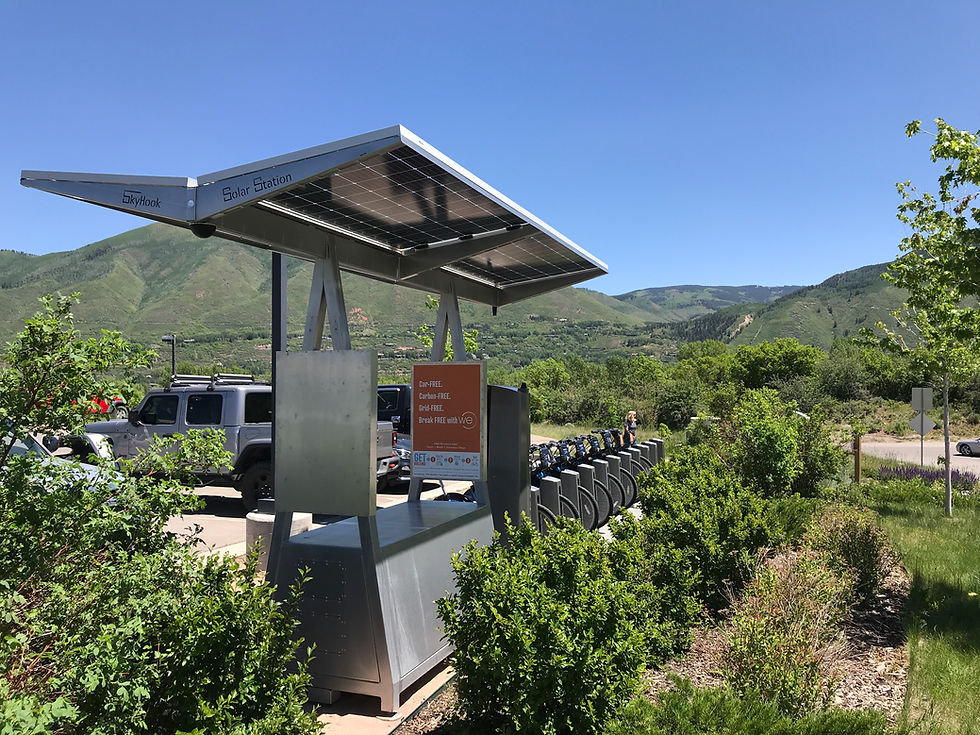
Looking back at photos of our very first 2022 installation alongside our current network illustrates just how far off-grid urban solar technology has come. What began as a strategic test has proven to be a vital operational pillar for BIXI's day-to-day operations.

Skyhook 2022
By integrating autonomous solar charging directly into their docking footprint, BIXI unlocked three massive operational advantages:
1. Eliminating Manual Battery Swaps
Traditionally, off-grid or remote bikeshare stations rely on operation teams driving vans around the city to manually swap out depleted e-bike batteries. By generating power directly on-site, Skyhook stations maintain consistent charging thresholds at the dock. This keeps bikes charged where riders need them while drastically reducing vehicle miles traveled (VMT) by operations teams.
2. Rapid, Zero-Trenching Deployment
Securing long-term utility permissions and trenching through municipal sidewalks can delay infrastructure deployment by 12 to 18 months. Because Skyhook Solar Stations utilize non-invasive, weighted bases, they qualify as temporary equipment. This allowed BIXI to secure site permissions faster and deploy fully functional charging stations in hours rather than months without disturbing local streetscapes or tearing up pavement.
3. Multi-Season Resilience in Harsh Winters
Montréal winters are legendary for extreme sub-zero temperatures and heavy snowfall. To maintain uninterrupted power through long winter storm cycles, our Solar Stations are engineered with industrial LiFePO4 (Lithium Iron Phosphate) battery storage and bifacial solar canopies. The LiFePO4 chemistry provides exceptional thermal stability and safety, while bifacial panels harvest both direct overhead sunlight and ground reflection off surrounding snow.
Building the Future of Frictionless Urban Transit

The growth of the BIXI network proves that municipal transit expansion doesn't have to wait on traditional grid timelines. By pairing iconic local transit options with flexible, localized solar power, cities can build resilient, scalable mobility networks that adapt to real-time rider demand.
We want to extend a massive thank you to the entire team at BIXI Montréal for trusting Skyhook Solar as a clean energy partner since Day 1. Here’s to four incredible years of partnership, and to many more sun-powered, zero-emissions miles ahead!


Comments